Życie na Marsie: przetrwanie ludzkości w nowych warunkach
Exploring Life on Mars: Is Human Survival Possible?
Mars has captured the human imagination for decades, but the question remains: Can humans survive on the Red Planet? With technological advancements and planned missions, the possibility of living on Mars is closer than ever before. In this article, we dive into the challenges and opportunities of human existence on Mars.
The Challenges of Mars Colonization
The unforgiving Martian environment presents a myriad of challenges for human survival. First, Mars lacks a breathable atmosphere, comprising mainly carbon dioxide, necessitating artificial life support systems. Additionally, extreme temperatures, with variations from -125°C to 20°C, require innovative insulation and heating solutions.
Radiation exposure poses a serious threat, as Mars’ thin atmosphere and lack of a magnetic field offer little protection from cosmic and solar radiation. Prolonged exposure could lead to increased cancer risks, necessitating the development of habitats with integrated radiation shielding.
Furthermore, water scarcity is a critical issue. While in situ resources augmentation techniques aim to extract water from ice or the atmosphere, these processes need to be efficient and sustainable for long-term habitation.
Solutions and Opportunities for Sustainable Living on Mars
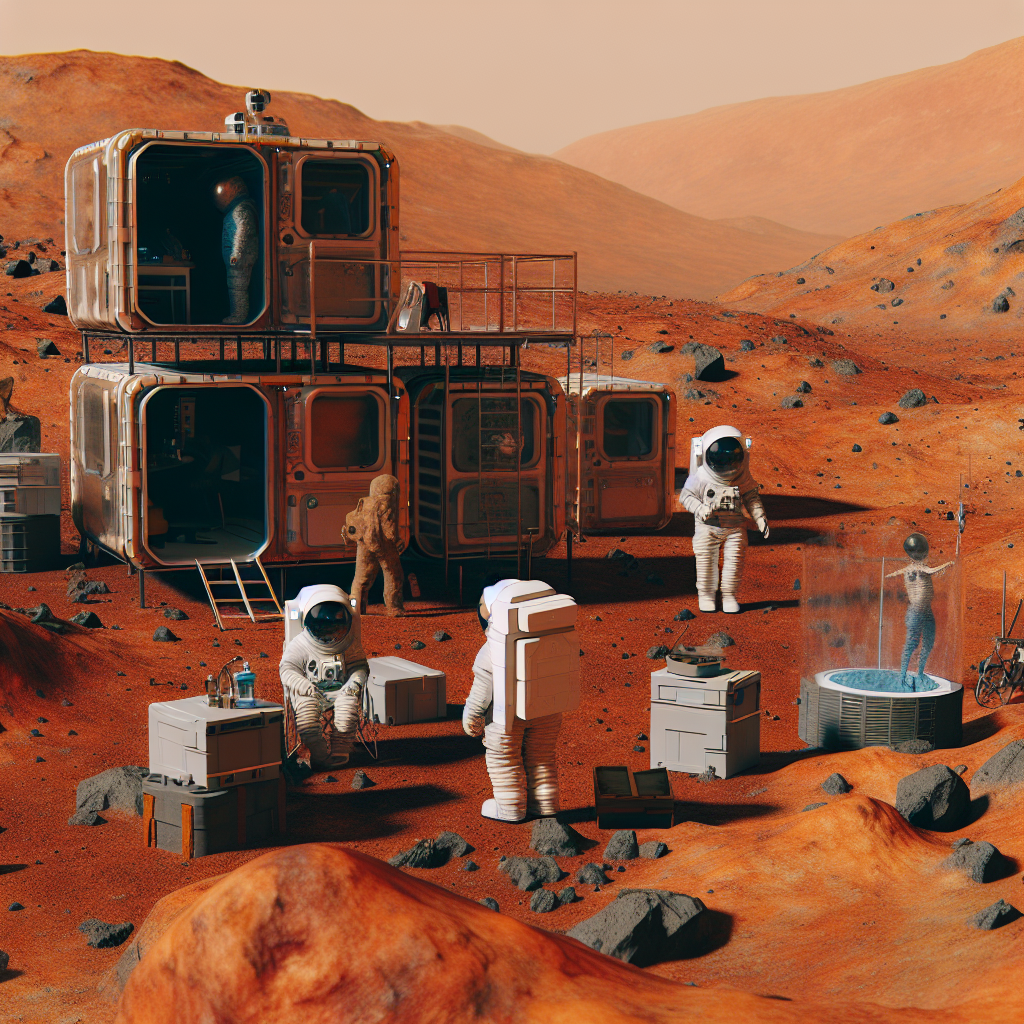
Despite the challenges, advances in technology offer promising solutions for sustainable living on Mars. **Artificial habitats** equipped with autonomous life support systems can maintain a breathable atmosphere, temperature control, and radiation shielding. Utilizing Martian regolith for habitat construction provides a feasible method to create durable, protective shelters.
Innovations in food production are key to self-sufficiency. Hydroponic and aeroponic systems, combined with genetically engineered crops, could supply the necessary nutrients while minimizing resource usage. Furthermore, closed-loop ecological systems can recycle waste materials, ensuring sustainability.
The potential for ISRU (In-Situ Resource Utilization) expands the possibilities of long-term Martian sustainability. Harvesting and utilizing local resources, such as water extraction techniques and oxygen production from carbon dioxide, could reduce the dependence on Earthly supplies.
Conclusion: Forging New Frontiers
While the challenges of establishing human life on Mars are considerable, technological innovations and scientific advancements make it increasingly feasible. By addressing environmental hurdles through sustainable solutions, humanity can create a blueprint for living beyond Earth. The road to Mars is paved with challenges, yet it represents the next frontier in human exploration, poised to redefine our existence and expand our reach into the cosmos.